Air Coming From Faucets in Hagerstown, MD: Private-Well Causes

Direct answer: Air spitting from faucets in a well-served home can follow service work or low water, but persistent air may involve the pump, drop pipe, check valve, tank, plumbing leak, or source conditions. Persistent sputtering at several cold taps is different from one faucet aerator or temporary air after service. Pressure changes, sediment, and the timing after heavy use add useful context.
Hagerstown and surrounding Washington County include public-water neighborhoods as well as outlying private-well properties. Private-well guidance applies only after confirming that the Hagerstown, MD property uses a well and identifying its pump, pressure tank, controls, gauge, piping, and demand.
Wenger Services serves Hagerstown, MD as a family-owned plumbing company with more than two decades of professional experience. "We don't charge to show up" is the stated visit policy. Any recommendation for the air-at-faucets well-system diagnosis should be based on what the technician confirms on site.
Need help with air-at-faucets well-system diagnosis? Review Wenger's well and water-pressure service options or use the Hagerstown, MD plumbing resource.
How to read the evidence around the air-at-faucets well-system diagnosis
Use sputtering at several cold-water fixtures as the starting observation, not the conclusion. The homeowner's role is to observe location, timing, sequence, and change. It is not to dismantle energized, pressurized, contaminated, or concealed equipment. The relationship to pressure changes with the air and cloudy-looking water that clears from the bottom upward gives the evidence meaning.
Warning signs that define the pattern
Sputtering at several cold-water fixtures. Photograph accessible evidence before cleanup when it is safe, but do not remove covers or enter contaminated areas.
Pressure changes with the air. Note whether the sign is new, gradually worsening, or returning after earlier work; recurrence can change the scope.
Cloudy-looking water that clears from the bottom upward. Record location, timing, duration, and what else is operating. This helps separate a local component from a connected-system condition.
One observation may define a local concern; several connected observations can widen the scope. For this air-at-faucets well-system diagnosis, compare the first and lowest affected points, hot and cold or supply and drain behavior where relevant, and any response to normal demand.
Possible causes that still need confirmation
Air entering the well or suction side. Access and service history determine whether a focused repair will address this cause.
Low water conditions. This remains a possibility until inspection or testing shows that it fits the complete operating pattern.
Leaks, controls, or recent system work. A connected component can create a similar symptom, so the cause should be demonstrated before parts are replaced.
Similar symptoms do not make the causes interchangeable. A complete air-at-faucets well-system diagnosis should establish whether the evidence points to air entering the well or suction side, another listed condition, or a limitation that requires additional access.
Narrow the pattern without creating a second problem
When scheduling, describe the location, timing, sequence, and affected fixtures or equipment. Add recent service, weather, power, remodeling, or demand changes only when they may explain the operating pattern.
Safe observations that make diagnosis more efficient
Compare several fixtures. Write down the result for comparison with professional findings.
Note whether only hot water is affected. Do not force a valve, cover, fitting, or control.
Record pressure behavior and when the condition began. Use ordinary operation only; repeated testing can enlarge the problem.
Know the stop point
Loss of water, repeated pump cycling, or air accompanied by sediment should be evaluated before continued heavy use.
Do not open energized control boxes. That can erase the symptom pattern or create another failure.
Do not repeatedly reset tripped protection. The shortcut can damage connected equipment and make diagnosis less reliable.
Do not assume a pressure-tank symptom proves the tank itself has failed. Use the safe observation steps for this property instead.
What Wenger evaluates for the air-at-faucets well-system diagnosis
A complete professional response does more than confirm that a symptom exists. It should test pressure behavior and evaluate the pump, tank, controls, switches, wiring, and accessible plumbing as a connected system and state the expected result of the recommended scope.
A step-by-step diagnostic path
Confirm where and when the first warning sign occurs, then identify every fixture or component affected by the same event. Record this stage for the Hagerstown, MD property file.
Compare the second warning sign with normal operation and preserve any accessible gauge, meter, alarm, moistur
e, flow, or sound evidence. Tie the finding to the reported operating pattern.
Inspect the pump, pressure tank, switch or controller, gauge, power supply, accessible piping, and the water source while testing the conditions most likely to separate air entering the well or suction side from low water conditions. Explain any access or testing limitation before the recommendation changes.
Determine whether the third listed cause explains the full pattern or whether access, cleaning, testing, or another system check is still needed. Show which evidence changed or confirmed the proposed cause.
Complete the approved correction and verify that the third reported condition is resolved or fully explained during ordinary use. Closeout should state normal operation and follow-up warning signs.
From symptom to a verified service scope
The investigation may involve well level, pump intake, drop pipe, check valve, pressure equipment, recent work, or plumbing leaks. Avoid heavy demand until repeated air and sediment are evaluated.
A clear proposal separates diagnosis, immediate correction, optional improvement, and adjacent restoration. For the air-at-faucets well-system diagnosis, the owner should know which evidence could still change cost or sequence.
Apply the guidance to the actual Hagerstown, MD property
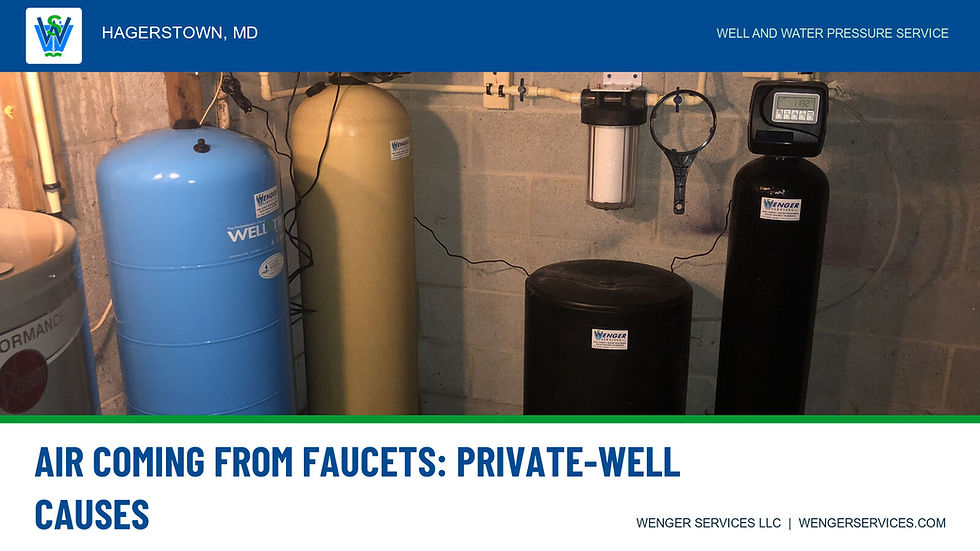
Private-well systems vary across Washington County. For the air-at-faucets well-system diagnosis, identify the pump, pressure tank, switch or controller, gauge, treatment equipment, access, and whether every fixture shows the same condition.
Questions to ask before approving the scope
Which observation best identifies the affected fixture, line, equipment, or water condition?
What test or inspection will distinguish the leading causes?
Can the affected system be used safely before service, and under what limits?
How will the completed work be tested against the original warning signs?
What should the Hagerstown, MD property owner watch for after service?
Keep a useful after-service record
Record normal cut-in, cut-out, or operating pressure when the system is healthy. Keep the result with model information and prior service records.
Keep the tank, controls, and shutoffs accessible. Recheck through normal use without forcing the condition to recur.
Respond to rapid cycling before it adds wear to the pump and controls. Update the record when the operating pattern changes.
After service, use ordinary operation to confirm the first reported condition is resolved or fully explained. Record any change in the second sign and note how soon the third sign returns, because recurrence becomes new diagnostic evidence.
Wenger service and local plumbing resources
Continue with Wenger's well and water-pressure service page, the Hagerstown, MD plumbing page, and Why a Sykesville Well Pump Short Cycles. The service page explains available work, while the location and related-article links add local and problem-specific context.
Frequently asked questions
Why does cloudy water clear from the bottom upward?
That pattern can indicate tiny air bubbles rising out of the water. Sediment tends to settle, but appearance alone does not determine water safety.
Can the visible symptom identify the cause by itself?
Usually not. For the air-at-faucets well-system diagnosis, air entering the well or suction side, low water conditions, and leaks, controls, or recent system work can overlap. Timing, scope, and testing are needed to separate them.
What should I stop using before service?
For the air-at-faucets well-system diagnosis, stop the affected fixture or equipment when continued use spreads water, sewage, heat, unstable pressure, or damage. Follow the topic-specific urgent guidance and use only a known safe shutoff.
Does this guidance apply to every Hagerstown, MD property?
Hagerstown, MD properties can differ in utility connection, well or septic use, building age, piping, equipment, and prior alterations. Confirm the actual system before applying advice that depends on a specific configuration.
Where can I learn more before requesting service?
Use the Wenger service and local plumbing links below, then review the related guide titled "Why a Sykesville Well Pump Short Cycles" as supporting context for the air-at-faucets well-system diagnosis. Those resources do not replace an evaluation of the property.
Request well and water-pressure service in Hagerstown, MD
If the warning signs described in this guide are present, stop unsafe use, preserve the operating pattern, and request an evidence-based diagnosis for the air-at-faucets well-system diagnosis. Contact Wenger Services through the matching service page for help in Hagerstown, MD and nearby Washington County communities. Wenger's stated policy is: "We don't charge to show up."


