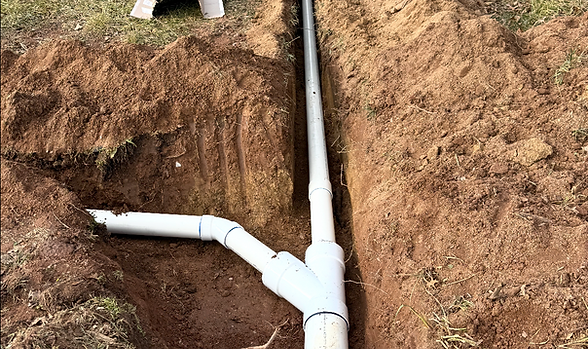
DOWNSPOUT DRAINAGE INSTALLATION
Underground Downspout Drainage That Moves Roof Runoff Away
When a downspout empties beside the house, roof water can collect near the foundation, wash out landscaping, cross a walkway, or leave the yard soggy after every storm. Wenger Services installs buried downspout drainage lines that carry runoff toward a site-appropriate outlet.

LICENSED
Local Plumber
INSURED
Local Contractor
TRUSTED
By Hundreds
Why Homeowners Trust Wenger With Water-Management Projects
A drainage line should solve the runoff problem without creating a new one somewhere else. See what local homeowners say about Wenger’s communication, professionalism, and care around their properties.
CONTROL ROOF RUNOFF
Move Downspout Water Away From Foundations and Walkways
Roof runoff released at the foundation can contribute to pooling, soil and mulch washout, soggy planting beds, wet walkways, and ice where water crosses traffic areas.
A buried downspout line creates a defined path for that water, moving it away from the house instead of letting it discharge at the same problem spot after every storm.


SITE-SPECIFIC ROUTES & OUTLETS
A Buried Drainage Line Needs a Real Destination
The pipe is only one part of a working drainage plan. Wenger evaluates the:
-
downspout location
-
grade
-
soil
-
utilities
-
route
-
access
-
maintenance needs
-
elevation of the proposed outlet.
Depending on the property and local rules, the system may discharge to daylight, a pop-up emitter, a dry well, or another approved location that does not shift the problem to a neighbor or public area.
Our Top Plumbing Locations Map
Wenger serves homeowners throughout its mapped plumbing service area. Use the interactive map to explore nearby locations, then contact us to confirm downspout drainage availability for your property.
Gutter Line Installation in Three Simple Steps
Step 1: Contact Wenger
Tell Wenger which downspouts cause trouble and where water pools, washes soil away, crosses a walkway, or stays in the yard. Photos taken during or after rain can be especially useful.
Step 2: Identify Your Problem
The property is reviewed for grade, soil, utilities, pipe route, access, outlet elevation, maintenance points, and any local discharge restrictions.
Step 3: Implement Solution
Wenger installs the approved drainage route, checks the flow path, completes the selected outlet, and restores disturbed areas included in the project scope.
SIGNS & SYSTEM PLANNING
Is Your Downspout Drainage Doing Its Job?
The right design depends on roof runoff, the number and location of downspouts, yard grade, soil, nearby utilities, pipe length, outlet elevation, traffic areas, maintenance access, and local stormwater rules. The best solution is the one that fits the property, not a one-size-fits-all kit.
Tell Us Where the Water Goes
Share the project address, number of problem downspouts, where water currently collects, and any existing buried pipe. If the form supports uploads, include photos from during or after a rainfall.
Guaranteed Workmanship
No Hidden Dispatch Fees
Fast, Local Service
Downspout Drainage Installation FAQs
What is an underground downspout drainage line?
It is a buried pipe that receives water from a roof-gutter downspout and carries it to a planned outlet away from the discharge point. It is also called a buried downspout, gutter drainage line, or downspout drainage system.
Is downspout drainage the same as installing roof gutters?
No. Roof gutters collect water along the roof edge, and downspouts bring it to ground level. This service page is for the drainage line that carries water away after it reaches the bottom of the downspout. Confirm separately whether Wenger’s current scope includes roof-gutter replacement or repair.
Is it a good idea to bury downspouts underground?
It can be when the system has a suitable route, consistent fall, durable connections, maintenance access, and a lawful outlet. A buried pipe without enough slope or a real discharge point can hold water, clog, or move the problem to another area.
Where does the downspout water go?
The outlet depends on the property. Possibilities may include daylight at a lower part of the lot, a pop-up emitter, a dry well, or another approved discharge point. Soil, grade, utilities, neighboring properties, and local stormwater rules all affect the decision.
How deep should an underground downspout line be?
There is no single depth for every property. The route must preserve usable slope and account for outlet elevation, soil, surface loads, landscaping, utilities, freezing conditions, pipe protection, and local requirements. Wenger determines the practical depth after reviewing the site.
What is the best pipe for underground downspout drainage?
Material should be selected for the route, soil, expected loads, connections, maintenance needs, and outlet. Smooth-wall solid pipe and corrugated products perform differently. Wenger can recommend a material after evaluating the property instead of choosing by keyword or kit alone.
How much does it cost to run downspouts underground?
Cost depends on the number of downspouts, pipe length, depth, soil and rock, utilities, access, trenching, crossings, fittings, cleanouts, outlet type, and restoration. A short open-yard route is different from a long run under hardscape or through difficult soil.
Can more than one downspout connect to the same buried line?
Sometimes, but the shared line and outlet must be able to handle the combined runoff and the layout must remain maintainable. Wenger will review the roof areas, pipe route, junctions, and outlet before recommending a combined system.
Do buried downspout lines clog or freeze?
They can if leaves and debris enter the line, joints fail, roots intrude, the pipe is crushed, slope is poor, or the outlet is blocked. A route that drains fully and includes appropriate maintenance access reduces risk, but no exterior drainage system is maintenance-free.
How do I know whether an existing buried line needs repair or replacement?
Warning signs include water backing up at the downspout, persistent overflow in moderate rain, soft or sunken ground along the route, water appearing where it should not, or no flow at the outlet. An assessment can identify whether cleaning, a localized repair, rerouting, or replacement is the practical next step.