Frederick County Water Heater Installation Checklist

Direct answer: A water-heater installation should be reviewed as a complete system: water connections, shutoffs, energy supply, drainage, relief piping, expansion control, access, and safe clearances. A replacement heater must fit more than the footprint. Capacity, energy source, venting or condensate, relief discharge, drainage, expansion control, shutoffs, electrical or gas connections, and service clearance all belong in the plan.
Frederick County covers urban, suburban, and rural properties with different water sources, building ages, and equipment. For the water-heater installation review, heater type, energy source, household demand, water conditions, installation, and access should guide the recommendation.
Wenger Services brings more than two decades of professional plumbing experience to Frederick County, MD and the wider Frederick County service area. The business is family owned and states, "We don't charge to show up." This guide does not replace the property-specific evaluation.
Need help with water-heater installation review? Review Wenger's water heater service options or use the Frederick County, MD plumbing resource.
Build the water-heater installation review before work starts
Planning should make rework visible before it happens. Record the status, responsibility, and closeout evidence for each condition below.
Project conditions that must be resolved
Corroded or unsupported connections. Add this item to the decision log with an owner, required information, due date, and the work it can hold up.
Improper drainage or relief discharge. Resolve the condition before affected installation, excavation, testing, inspection, or finish work makes correction more disruptive.
Limited access for inspection and future service. Identify the current document, specification, or field measurement that will close this coordination item.
Sequence decisions from concealed infrastructure to visible finishes. Resolving plumbing constraints before ordering or closing work preserves more choices and reduces avoidable delay.
Common sources of rework and delay
An incomplete prior installation. Document how this issue affects schedule, inspections, access, adjacent trades, and completed finishes.
Equipment or energy-source changes. A contingency is appropriate only when the condition cannot reasonably be verified before access is opened.
Aging valves, piping, supports, or safety components. Assign responsibility and resolve this coordination gap before it becomes field rework.
Late changes are sometimes unavoidable, but undocumented changes are not. Record the effect on routing, access, testing, inspections, other trades, and completed work before approving the revision.
Decisions and field information to settle early
Use a coordination log for the water-heater installation review. Each item should show status, responsible party, required information, due date, and the rough-in, test, inspection, or finish work it affects.
Planning checks to complete before the next phase
Record the model and energy source. Name any unresolved follow-up before affected work proceeds.
Photograph visible connections and the surrounding space. Do not let adjacent work conceal the condition before review.
Keep stored items away from the unit and leave controls closed. Record how this check affects access, sequence, or scope.
Know the stop point
Gas odor, backdrafting concern, scorching, pressure discharge, or water near electrical equipment requires prompt professional attention.
Do not remove electrical or burner access panels. Document the condition and obtain the required decision before affected work advances.
Do not cap or operate a leaking safety valve. That can create injury, contamination, damage, rework, or an inspection delay.
Do not drain a hot pressurized tank without the correct procedure. Use verified access and the approved project procedure instead.
What Wenger evaluates for the water-heater installation review
Wenger's planning role is to review the heater, energy source, controls, safety devices, water connections, venting or condensate where applicable, and household demand and record open selections, access limits, trade conflicts, and project hold points.
A practical project sequence
Confirm the goal of the water-heater installation review, the final product or system information, and the field dimensions or records needed to begin. Add this stage to the Frederick County, MD project record.
Review the heater, energy source, controls, safety devices, water connections, venting or condensate where applicable, and household demand and identify which components will remain, move, be protected, or require access. Record conflicts and decisions in the current project set.
Resolve utilities, routing, clearances, adjacent trades, occupied-space impacts, and any inspection or permit milestones before installation advances. Release affected work only after required coordi
nation is complete.
Document contingencies that cannot be settled until access is opened, and define how the owner will approve a scope change. Record the approval path for any field change.
Test the completed work, record concealed conditions where useful, and provide operation, access, and maintenance information at closeout. Closeout should include tests, inspections, access, and maintenance information.
Turn the plan into a clear sequence of work
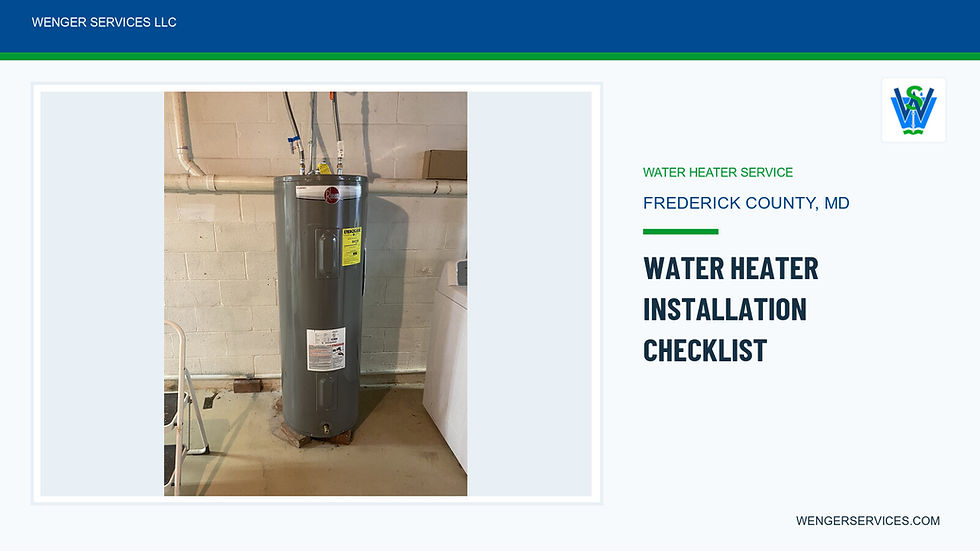
Photographs and model information help prepare the visit, but the final selection should follow verified demand and field conditions. Existing deficiencies should not be copied into the new installation.
The water-heater installation review should end with a buildable sequence rather than a general intention. Name the next hold point, required evidence, and party responsible for release.
Apply the guidance to the actual Frederick County, MD property
For the Frederick County, MD water-heater installation review, provide heater type, energy source, model, age when known, household demand, water conditions or treatment, visible connections, and service access. Public sewer or septic status usually does not affect this decision.
Questions to ask before approving the scope
Which field conditions can still change the water-heater installation review?
What must be selected, approved, or inspected before the next phase?
Who is responsible for access, adjacent finishes, testing, and restoration?
How will completed work be checked against approved documents, field conditions, and inspection requirements?
What should the Frederick County, MD property owner watch for after service?
Preserve the project and closeout record
Keep the manufacturer's information and installation records accessible. Record the responsible party and completion status before the next phase.
Watch for changes in recovery, sound, color, odor, or moisture. Preserve test, inspection, and concealed-work information for closeout.
Match maintenance to the heater type, water conditions, and manufacturer guidance. Update the plan when an approved field change affects access or future service.
At closeout, compare installed work with approved documents and field decisions. Retain testing, inspections, product information, concealed-work photographs where useful, valve or component locations, and maintenance instructions.
Wenger service and local plumbing resources
Continue with Wenger's water heater service page, the Frederick County, MD plumbing page, and Water Heater Maintenance for Columbia Homes. The service page explains available work, while the location and related-article links add local and problem-specific context.
The U.S. Department of Energy provides general water-heating technology and efficiency information. Use product instructions and a property-specific inspection when making decisions about water heater installation.
Frequently asked questions
Can a new water heater always use the old connections?
Not necessarily. Equipment dimensions, energy requirements, venting, drainage, safety components, shutoffs, and local requirements may change the connection scope.
Why are product specifications important before work begins?
Specifications define dimensions, connections, clearances, utilities, and service needs that can change the water-heater installation review. A product name or photograph is not enough for rough-in.
What should be documented before walls, floors, or soil are closed?
Keep approved changes, test and inspection results, photographs where useful, component locations, and any operation or maintenance information relevant to the completed work.
Does this guidance apply to every Frederick County, MD property?
Frederick County, MD properties can differ in utility connection, well or septic use, building age, piping, equipment, and prior alterations. Confirm the actual system before applying advice that depends on a specific configuration.
Where can I learn more before requesting service?
Use the Wenger service and local plumbing links below, then review the related guide titled "Water Heater Maintenance for Columbia Homes" as supporting context for the water-heater installation review. Those resources do not replace an evaluation of the property.
Request water heater service in Frederick County, MD
If you are preparing a water-heater installation review, bring the available records, field dimensions, product information, access questions, and project schedule to the first review. Contact Wenger Services through the matching service page for help in Frederick County, MD and nearby Frederick County communities. Wenger's stated policy is: "We don't charge to show up."